Algebra 1 Curriculum Overview
This course establishes a strong foundation, covering real numbers, linear equations, systems, ratios, geometry applications, polynomials, and logical reasoning skills․
I․ Foundations of Algebra
This initial section builds the essential groundwork for all subsequent algebraic concepts․ Students will deeply explore the real number system, mastering operations with integers, rational numbers, and understanding the nuances of irrational numbers, including square roots․ A crucial component involves recognizing and applying the properties of real numbers – commutative, associative, and the powerful distributive property – to simplify expressions and solve problems․
This isn’t merely about memorization; it’s about developing a conceptual understanding of how numbers interact․ Students learn to identify the structure of expressions, building upon arithmetic foundations established in earlier grades․ This strong base is vital for successfully navigating more complex algebraic manipulations later in the curriculum, ensuring a solid understanding of fundamental principles․
A․ Real Number System & Operations
This module comprehensively examines the building blocks of algebra: the real number system․ Students will categorize numbers – integers, rational, and irrational – and understand their unique characteristics․ Core skills include performing all four basic operations (addition, subtraction, multiplication, and division) with these numbers, including positive and negative values․ Emphasis is placed on mastering operations with fractions, decimals, and square roots․
Furthermore, students will learn to simplify expressions involving these operations, adhering to the order of operations (PEMDAS/BODMAS)․ This foundational understanding is crucial, as all subsequent algebraic concepts rely on a firm grasp of real number manipulation․ The goal is not just procedural fluency, but a conceptual understanding of why these operations work․

B․ Properties of Real Numbers (Commutative, Associative, Distributive)
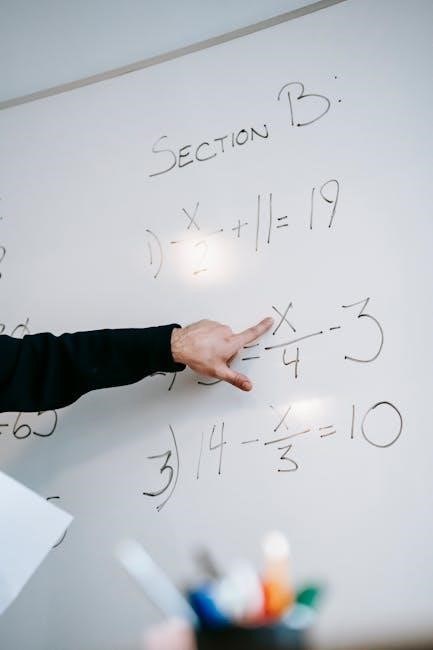
This section delves into the fundamental rules governing mathematical operations․ Students will explore and apply the commutative property (order doesn’t matter in addition/multiplication), the associative property (grouping doesn’t matter in addition/multiplication), and the crucial distributive property (a(b+c) = ab + ac)․ Understanding these properties isn’t just about memorization; it’s about recognizing why certain algebraic manipulations are valid․
These properties serve as the bedrock for simplifying expressions and solving equations․ Students will practice applying these properties to rewrite expressions in equivalent forms, preparing them for more complex algebraic tasks․ Mastery of these concepts allows for efficient and accurate problem-solving, and builds a strong foundation for future mathematical study․
II; Linear Equations and Inequalities
This core unit focuses on the building blocks of algebra: linear relationships․ Students will learn to solve equations with one variable, employing inverse operations to isolate the unknown․ A significant portion is dedicated to mastering inequalities – understanding how to solve them and represent solutions graphically on a number line․ This includes recognizing the impact of multiplying or dividing by negative numbers, which reverses the inequality sign․
Furthermore, students will translate real-world scenarios into linear equations and inequalities, fostering problem-solving skills․ Graphing linear equations provides a visual representation of these relationships, solidifying understanding and preparing them for systems of equations later in the curriculum․
A․ Solving One-Variable Equations
Students begin by understanding the concept of an equation as a statement of equality, and the goal of solving is to isolate the variable; This section emphasizes utilizing inverse operations – addition/subtraction, multiplication/division – to maintain balance while manipulating the equation․ A key focus is on simplifying expressions before solving, applying the distributive property when necessary․
The curriculum progresses from simple one-step equations to more complex multi-step equations, including those with variables on both sides․ Students learn to check their solutions by substituting them back into the original equation, ensuring accuracy․ Real-world applications are integrated to demonstrate the practical relevance of equation-solving skills․
B․ Solving One-Variable Inequalities
Building upon equation-solving skills, this section introduces inequalities and their symbols (>, <, ≥, ≤)․ Students learn that solving an inequality aims to find a range of values that satisfy the statement, rather than a single solution․ A crucial concept is understanding how multiplying or dividing both sides by a negative number reverses the inequality sign․
The curriculum covers solving multi-step inequalities, including those with variables on both sides, mirroring the progression used for equations․ Graphing solutions on a number line is emphasized, visually representing the solution set․ Students practice translating word problems into inequalities and interpreting the resulting solutions in context, reinforcing practical application․
C․ Graphing Linear Equations
This section visually represents linear relationships․ Students learn to graph equations using several methods, starting with creating a table of values – selecting x-values, calculating corresponding y-values, and plotting the points․ Emphasis is placed on understanding the coordinate plane and accurately plotting points․
The curriculum then introduces the slope-intercept form (y = mx + b), enabling students to quickly identify the slope (m) and y-intercept (b) and graph the line directly․ Students practice determining the slope from a graph and writing equations given the slope and y-intercept․ Finally, they learn to graph equations in standard form (Ax + By = C), often by converting them to slope-intercept form first․
III․ Systems of Linear Equations
This unit focuses on solving sets of two or more linear equations simultaneously․ Students begin by understanding that a solution to a system is an ordered pair that satisfies all equations within the system․ Graphical representation is the initial approach, where students identify the point of intersection of two lines as the solution․
The curriculum progresses to algebraic methods: substitution and elimination․ Substitution involves solving one equation for one variable and substituting that expression into the other equation․ Elimination (or addition) involves manipulating equations to eliminate one variable when added together․ Students learn to choose the most efficient method based on the equation structure․
A․ Solving Systems by Graphing
Students visually determine the solution to a system of two linear equations by graphing both equations on the coordinate plane․ The point where the lines intersect represents the solution – the (x, y) values that satisfy both equations simultaneously․ If the lines intersect, there’s one unique solution․
Parallel lines indicate no solution, as they never intersect, meaning there are no common (x, y) points․ Coinciding lines (the same line) signify infinite solutions, as every point on the line satisfies both equations․ Emphasis is placed on accurately graphing lines in slope-intercept form (y = mx + b) and interpreting the graphical results to understand the nature of the system’s solution․
B․ Solving Systems by Substitution
This method involves solving one equation for one variable and then substituting that expression into the other equation․ This creates a single equation with one variable, which can then be solved․ Once the value of that variable is found, it’s substituted back into either original equation to solve for the other variable․
Substitution is particularly effective when one equation is already solved for a variable, or easily manipulated to be so․ Students learn to carefully manage algebraic expressions and avoid common errors during the substitution process․ The solution is expressed as an ordered pair (x, y), and checking the solution in both original equations is emphasized to ensure accuracy․
C․ Solving Systems by Elimination
The elimination method, also known as the addition method, focuses on manipulating the equations so that when added together, one of the variables is eliminated․ This is achieved by multiplying one or both equations by a constant so that the coefficients of either x or y are opposites․ Adding the equations then results in a single equation with one variable․

Students practice identifying appropriate multipliers and carefully performing the addition․ Solving for the remaining variable and substituting back into either original equation yields the solution․ This method is particularly useful when equations aren’t easily solved for a single variable using substitution, offering an alternative pathway to finding the solution as an ordered pair․
IV․ Ratios, Proportions, and Percentages
This section delves into the relationships between quantities, starting with understanding ratios as comparisons and proportions as statements of equality between ratios․ Students learn to identify proportional relationships in real-world scenarios and solve proportions using cross-multiplication․ A key focus is applying these concepts to percentage problems, including calculating percentages of a number, finding percentage increases and decreases, and solving problems involving discounts and markups․
Emphasis is placed on translating word problems into mathematical equations and interpreting the results in context․ Students will master practical applications like calculating sales tax, tips, and simple interest, building financial literacy alongside algebraic skills․
A․ Understanding Ratios and Proportions
Students begin by defining a ratio as a comparison of two quantities, expressed in various forms – fraction, colon, or using the word “to”․ They learn to simplify ratios and recognize equivalent ratios․ The concept of a proportion is then introduced as an equation stating the equality of two ratios․
A core skill developed is determining if ratios form a proportion, often utilizing cross-multiplication as a verification method․ Real-world applications are emphasized, such as scaling recipes, map scales, and similar figures․ Students practice solving for missing values in proportions, solidifying their understanding of proportional relationships and their utility in problem-solving․
B․ Percentages, Discounts, and Markups
This section builds upon the understanding of ratios and proportions, transitioning to the concept of percentages as a ratio out of 100․ Students learn to convert between percentages, decimals, and fractions, mastering these essential representations․ They apply this knowledge to calculate percentages of a given number, a foundational skill for numerous applications․
Practical problems involving discounts and markups are central to this unit․ Students learn to calculate the amount of a discount and the sale price after the discount is applied․ Similarly, they determine the markup amount and the final selling price․ These skills are reinforced through real-world scenarios, fostering financial literacy and problem-solving abilities․
V․ Algebraic Applications in Geometry
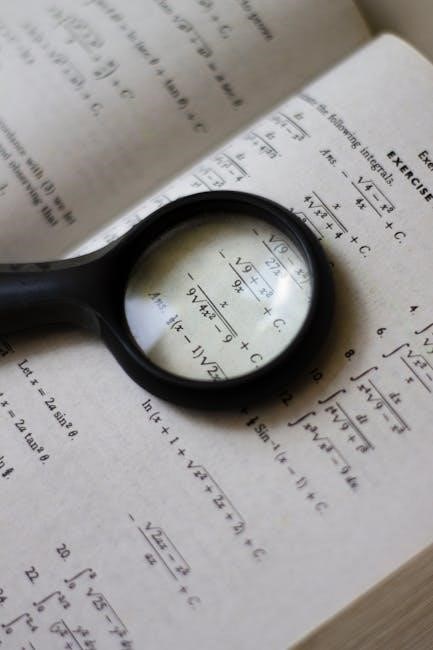
This unit bridges the gap between algebra and geometry, demonstrating how algebraic principles can be used to solve geometric problems․ A core focus is the Pythagorean Theorem, where students learn to apply the formula (a² + b² = c²) to find missing side lengths in right triangles․ This involves understanding square roots and simplifying radicals, reinforcing earlier algebraic concepts․
Furthermore, students explore area and volume formulas for various geometric shapes, including rectangles, triangles, and basic three-dimensional figures․ They practice substituting variables and solving for unknown dimensions, solidifying their algebraic manipulation skills․ This application provides a visual and contextual understanding of algebraic equations, enhancing comprehension and retention․
A․ Pythagorean Theorem
Students will delve into the foundational Pythagorean Theorem (a² + b² = c²), understanding its historical context and geometric proof․ The focus extends beyond memorization to practical application, solving for unknown side lengths in right triangles․ This involves mastering square roots and simplifying radicals – crucial algebraic skills reinforced through geometric problems․
Real-world scenarios, such as finding the diagonal of a rectangle or the height of a leaning object, will be explored to demonstrate the theorem’s relevance․ Students will practice setting up equations, substituting values, and solving for unknowns, strengthening their algebraic manipulation abilities․ Emphasis will be placed on identifying right triangles within complex figures and applying the theorem appropriately․
B․ Area and Volume Formulas
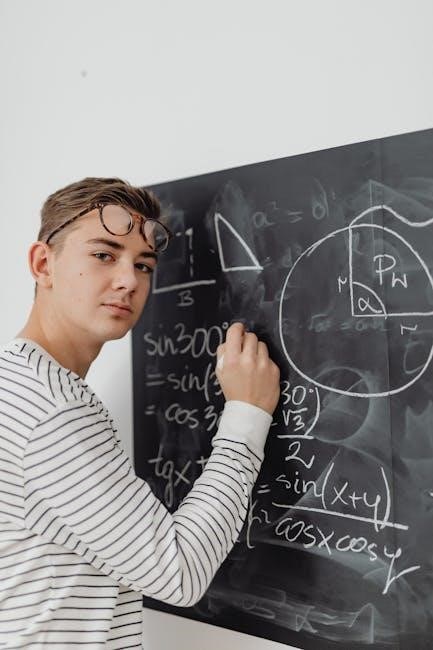
This section bridges algebra and geometry, focusing on applying algebraic principles to calculate area and volume․ Students will revisit and expand upon formulas for common shapes – triangles, rectangles, circles, and their three-dimensional counterparts: prisms, cylinders, pyramids, and cones․ The emphasis isn’t merely on formula recall, but on understanding why these formulas work․
Students will practice substituting variables, evaluating expressions, and solving for unknown dimensions given area or volume․ Problems will involve units of measurement and conversions, reinforcing dimensional analysis․ More complex scenarios, like finding the area of composite figures or the volume of irregular shapes, will challenge students to break down problems into manageable algebraic components, solidifying their problem-solving skills․
This unit marks a transition towards more abstract algebraic concepts, beginning with polynomials․ Students will learn to identify polynomials based on their degree and number of terms – monomials, binomials, and trinomials․ The initial focus is on mastering basic operations: addition and subtraction of polynomials․ This involves combining like terms, paying close attention to the distributive property and maintaining correct signs․
Building upon this foundation, students will progress to multiplying polynomials, starting with monomial times polynomial and then expanding to binomial times binomial․ Techniques like the FOIL method will be introduced and practiced․ The goal is to develop fluency in manipulating polynomial expressions, preparing them for future topics like factoring and solving polynomial equations․
A․ Basic Polynomial Operations (Addition, Subtraction)
Students begin their exploration of polynomials by mastering addition and subtraction․ This involves identifying like terms – terms with the same variable and exponent – and then combining their coefficients․ A strong understanding of integer operations is crucial here, as coefficients can be positive or negative․ The distributive property plays a key role when dealing with polynomials enclosed in parentheses․
Careful attention to detail is emphasized, particularly regarding signs․ Students practice simplifying expressions by correctly applying the rules for adding and subtracting both positive and negative terms․ This foundational skill is essential for success in more complex polynomial operations, such as multiplication and factoring, encountered later in the curriculum․
B․ Multiplying Polynomials
Building upon addition and subtraction, students tackle the multiplication of polynomials․ This initially focuses on multiplying a monomial by a polynomial, applying the distributive property to ensure each term within the polynomial is multiplied by the monomial․ The next step involves multiplying two binomials, often visualized using the FOIL method (First, Outer, Inner, Last) as a mnemonic device․
As complexity increases, students extend these techniques to multiply polynomials with more than two terms․ Emphasis is placed on systematic distribution and careful combination of like terms to arrive at a simplified final expression․ Mastery of this skill prepares students for factoring and solving polynomial equations in subsequent units, solidifying their algebraic manipulation abilities․
VII․ Logic and Reasoning

This section transitions from computational skills to abstract thinking, introducing students to the fundamentals of logical statements․ They learn to identify statements as true or false, and to recognize different types of logical statements, including conditional statements (“if-then”) and their converses, inverses, and contrapositives․
Students explore basic logical operations like “and,” “or,” and “not,” understanding how these operators affect the truth value of combined statements․ This builds a foundation for deductive reasoning and proof construction, skills crucial not only in mathematics but also in various real-world applications․ The goal is to cultivate critical thinking and the ability to analyze arguments effectively․
A․ Identifying Logical Statements
Students begin by discerning statements from non-statements․ A logical statement is a declarative sentence that can be definitively classified as either true or false – opinions or questions don’t qualify․ They practice identifying these statements within mathematical contexts and everyday language, recognizing the importance of precise wording․
This involves understanding the concept of truth values and applying them to simple algebraic expressions and equations․ Students learn to analyze whether a given statement holds true for all values of a variable, or only for specific ones․ This foundational skill is essential for evaluating the validity of arguments and building more complex logical reasoning abilities later in the course․
B․ Basic Logical Operations
Building upon statement identification, students explore fundamental logical operations: conjunction (AND), disjunction (OR), and negation (NOT)․ They learn to represent these operations symbolically and construct truth tables to determine the truth value of compound statements․ For example, understanding “x > 5 AND x < 10” requires evaluating both conditions simultaneously․

This section emphasizes how these operations apply to algebraic statements and inequalities․ Students practice combining simple inequalities using “AND” and “OR”, interpreting the resulting solution sets․ They also learn to negate algebraic statements correctly, understanding how negation affects the solution․ These skills are crucial for constructing valid mathematical arguments and proofs throughout Algebra 1 and beyond․